Standards
Coverage, including where there is none.
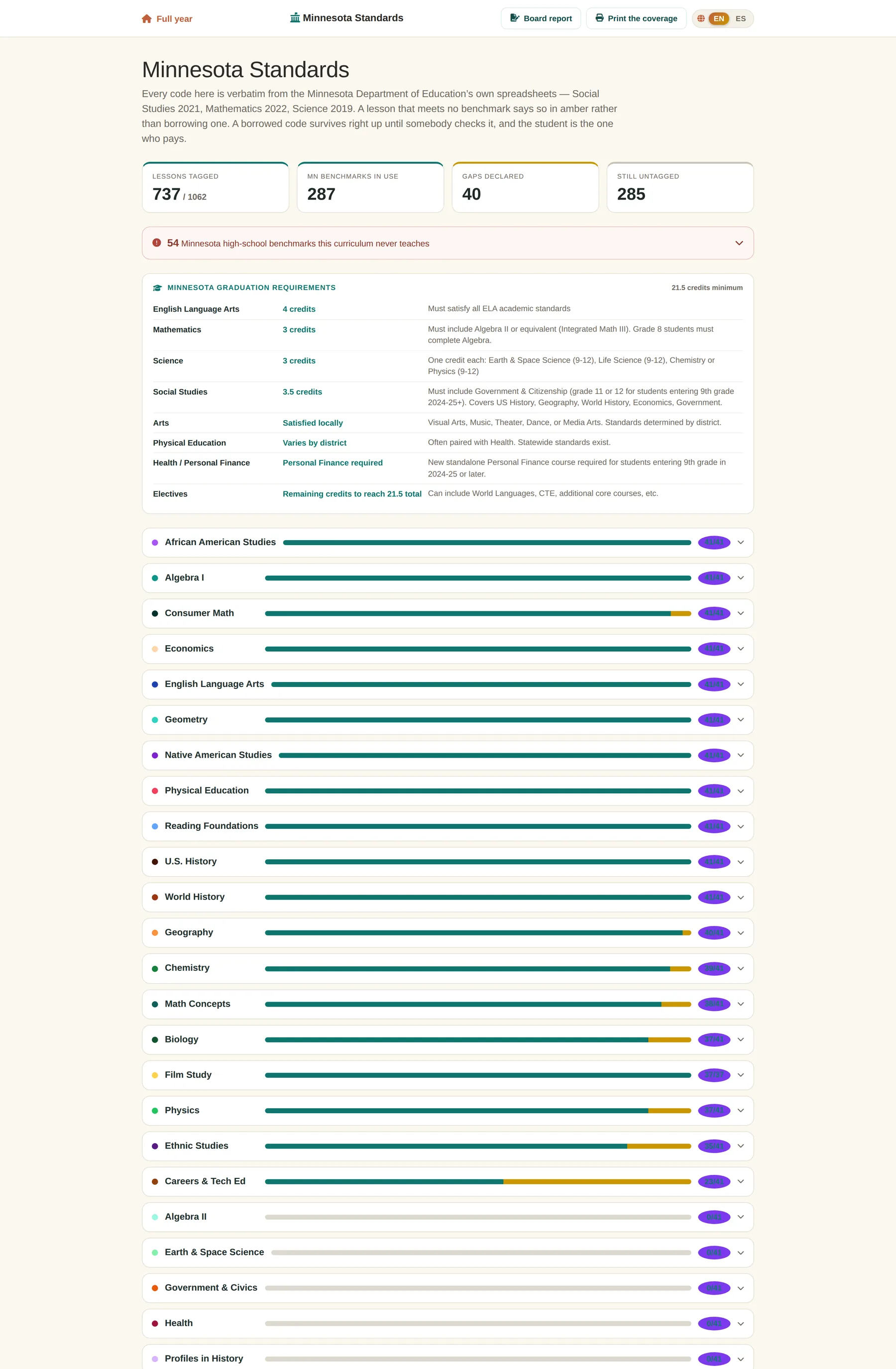
Each day is tagged so you can tell what a sheet actually reinforces before you hand it out. Every benchmark code in the hub is verbatim from the Minnesota Department of Education’s own spreadsheets — Social Studies 2021, Mathematics 2022, Science 2019 — and a lesson that meets no benchmark is marked as meeting none.
The last three numbers are the point. Every one of the 1,062 lessons now either carries a Minnesota benchmark or says plainly that it does not — none is left silent. A curriculum that claims full coverage instead is easy to write and impossible to defend. A borrowed code survives right up until somebody checks it, and the student is the one who pays.
Coverage by subject
Out of the weeks each subject is scheduled to teach. A bar at zero does not mean the work is outstanding; it means Minnesota publishes no benchmark that the subject can honestly claim. Those weeks are declared in amber inside the hub and carry a named national framework beside them instead.
The second line
Three subjects — Health, Social-Emotional Learning and Visual Art — sit at zero because Minnesota has not given them a benchmark set the hub can quote. Minnesota’s proposed health standards were disapproved by an administrative law judge in June 2026, so health remains locally determined. Social-emotional learning has no state standards at all. The state does publish arts benchmarks, and they are real, but their wording has not yet been read off Minnesota’s own file, so it stays out of the verified column until it has been.
Those lessons are not left blank. Each one keeps its amber notice, and beneath it a second, separately labelled line names the framework that does cover it — the National Health Education Standards, the CASEL competencies, the Career Ready Practices — with the source printed underneath. The two lines never merge. Nothing borrowed is ever given a Minnesota label.