Extended learning, ready to print
Extra credit that reinforces what you already teach.
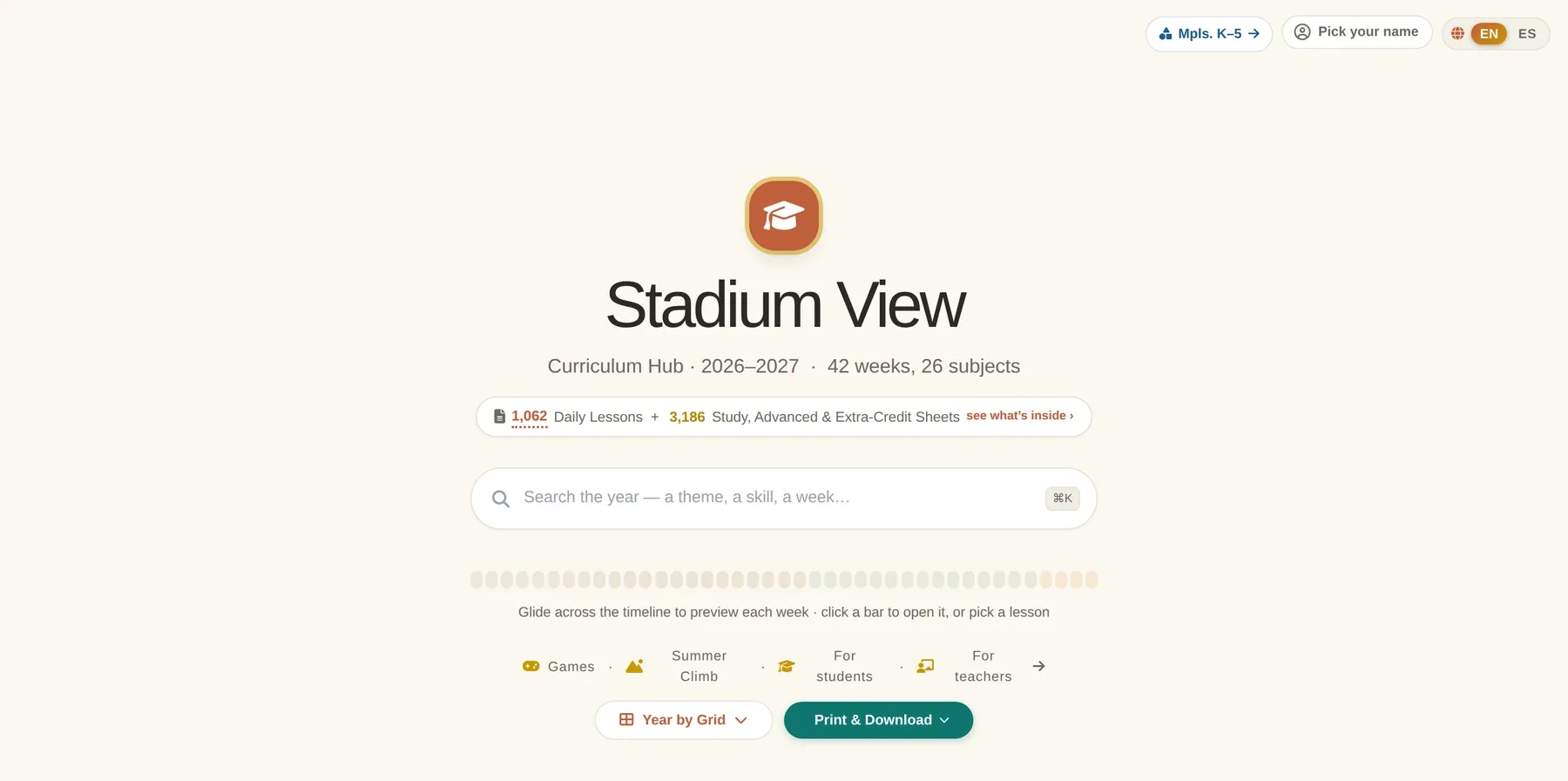
This is a library, not a program. Forty-two weeks and twenty-six subjects of extended-learning material — 1,062 daily lessons, 3,186 study and extra-credit sheets, and 31 skill games — filed by week and subject so a teacher can find the day they are on, print what fits it, and hand it to the student in front of them. It is not here to replace a classroom. It is here to give one somewhere to go next.
Opens the working hub. Nothing to install, nothing to sign into, nothing to adopt.
Two minutes on what it is for
One student needs more of today. This follows that from the week you are on down to the extra-credit sheet behind the lesson you just taught — what is on it, what it is worth, and what comes out of the printer. The marks under it jump straight to any part, so you can watch the thirty seconds you care about and leave the rest.
What it is for
It was built to answer a narrow, ordinary question: what do you hand a student who needs more of today. Someone finishes twenty minutes early. Someone has been out a week and needs the same ground covered on their own. Someone got it, and wants a harder version. Someone did not, and needs the same idea from a different angle. Pick the subject, pick the day, print the sheet. What comes out reinforces the lesson that was already taught in the room.
Every one of those is the same wager: that a student learns a thing by meeting it more than once, and that the second meeting has to be within reach on the day it matters. A week away is a week of ground lost, and it does not come back on its own. A student reading two grades below the passage does not need an easier idea, they need the same idea written so they can get through it. A student four credits short does not need encouragement, they need work in hand that can be done, scored and counted. The material is filed the way it is so the answer to each of those takes under a minute to find — because the help that takes ten minutes to assemble is the help that does not get handed over.
The lesson plans are here for the same reason, and they are not a syllabus to adopt. They are another teacher’s version of the same day — the question they opened with, the vocabulary they pulled, the exit slip they used — to borrow an idea from when you are planning your own. Take one line or take the page. Nothing here asks a classroom to be run differently.
Everything has paper behind it, because printing is the point. A sheet reaches every student regardless of the device they have, it can go home, it can go in a folder, and it keeps working when the Chromebooks are out or the class moves rooms. A finished sheet is also evidence — something to score, to file, to hold up when the question is whether a student did the work and what it was worth.
And it is a website that does not need a web server. The whole hub is HTML you open in a browser; there is no login, no server to keep running, and no connection required once it is on the machine. Networks go down, logins expire and filters change without warning, and material you cannot reach at 8:05 on a Monday is material you do not use.
What none of this does is promise a number. There is no study behind this file and no claim that it moves a score. What it does is take away the reasons a student ends a period with nothing in front of them — nothing at their reading level, nothing for the day they missed, nothing harder for the one who finished early. Whatever gain there is comes the ordinary way: a student doing more work that is actually aimed at what they were just taught.
Filed by week and subject
Every week has a theme and a date range, so material is filed where you would look for it. Weeks 1–37 carry a lesson in all 26 subjects, weeks 38–41 carry 25, and week 42 is a closing week with none written yet. See the year →
Three sheets behind every day
A study sheet, a second study sheet and an extra-credit set for each of the 1,062 days, plus exit slips — and a plan and teaching notes if you want the idea rather than the paper. Look inside one →
The paper changes, quietly
Reading level, spacing, text size, shortened sets and one-task-per-page follow the child’s plan — and never appear on the child’s packet. How that works →
Keeping track of what went out
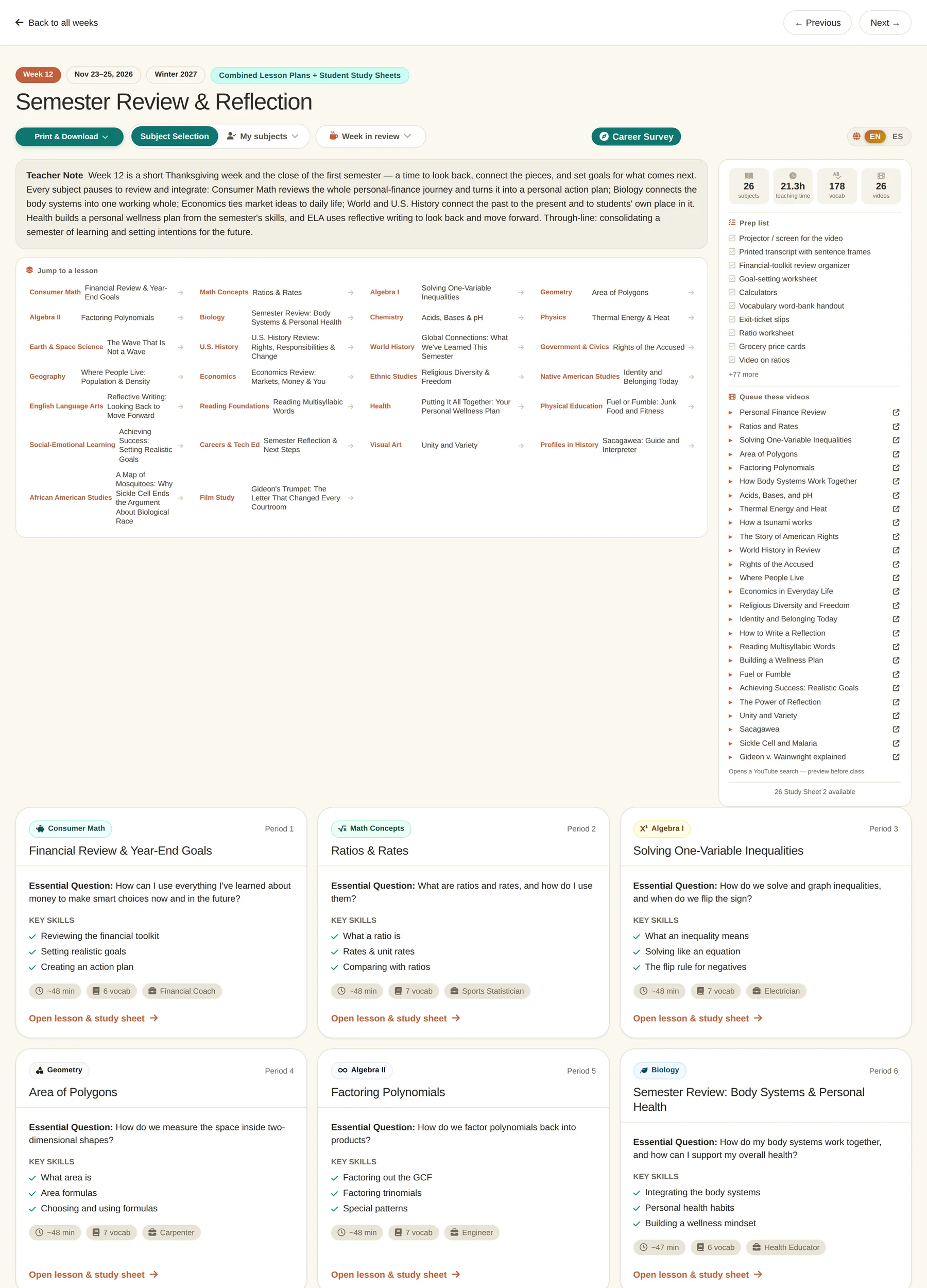
Week in Review is the page that makes a week findable. A teaching note that connects it across subjects, a jump map to every lesson in it, a prep list of what to gather, and the videos queued for that week — so you can see at a glance what is available, what you have already sent home, and what is left. Filter it to the subjects you actually teach and it stays filtered.
Honest about its gaps
Every sheet carries the Minnesota benchmark it reinforces, so you can check that the extra credit you are handing out lines up with the lesson it is meant to support. The hub reports that coverage in full — including where there is none. 877 of 1,062 lessons are tagged, 196 gaps are declared outright, and 54 Minnesota high-school benchmarks are listed as things this material does not cover.
A lesson that meets no benchmark is marked in amber rather than given a borrowed code. See the coverage report →